
What My Research Means to Me
Charlotte, North Carolina is home to more than 25,000 immigrant and refugee children and adolescents, spanning Charlotte-Mecklenburg Schools (CMS) to the city’s nine colleges and universities. As a child of immigrants myself, the experiences of these demographics are important to me. The immigrant and refugee population is often underrepresented and underfunded, especially within the institutions of education and mental health. The mental health aspect is especially pertinent to me as a Psychology major. My goal is to work with kids, which is why I focused on children and adolescents for this research. I also feel that the youth population is often disregarded in many conversations and often gets sidelined in conversations pertaining to immigration. That is what made it all the more important to me to spotlight this demographic in my research.
I started my ongoing research project focusing on the educational and psychological resources afforded to immigrant and refugee children as a part of a class project in my Sociological Approaches to Local Issues course. My professor and mentor, Dr. Diane Zablotsky, encouraged me and my classmates to think of our research beyond the letter grade and to apply for conferences taking place that year. The National Conference on Undergraduate Research (NCUR) and the UNC Charlotte University Research Conference (URC) were two of those conferences. After many late nights working on abstract submissions and poster presentations, I was given the amazing opportunity to talk about my research at both conferences.
For my research, I focused on the school-based institutions in Charlotte that provide both mental health and education resources. This includes CMS, as well as other neighboring universities in Charlotte and UNC Charlotte. I also included resource organizations such as ourBRIDGE for Kids and private institution, The Nest Academy. I covered each organization, and to what extent they provided specialized resources and programming to the immigrant and refugee student community. What I found is that there is a disconnect between traditional schools and outside resource organizations. My hope is that at some point, these schools can collaborate and build connections going both ways to help these students have access to educational resources as well as mental health care in a way that shows understanding for the cultures and backgrounds they come from. I was able to research resource organizations in Charlotte, as well get first-hand perspectives of some of the immigrant and refugee students to collect primary data for my research.
I was so excited to speak on this issue at both NCUR and the URC, while also engaging in critical conversations with many wonderful people I met at both conferences. At both conferences, I presented my research in the form of a poster and had students, faculty, and professionals from all over the country approach me and speak with me on my work and the importance of mental health and educational resources for this marginalized demographic. It was a great experience where I learned so much and where I was able to bring attention to and raise awareness for immigrants and refugees and their experiences in the US education system.
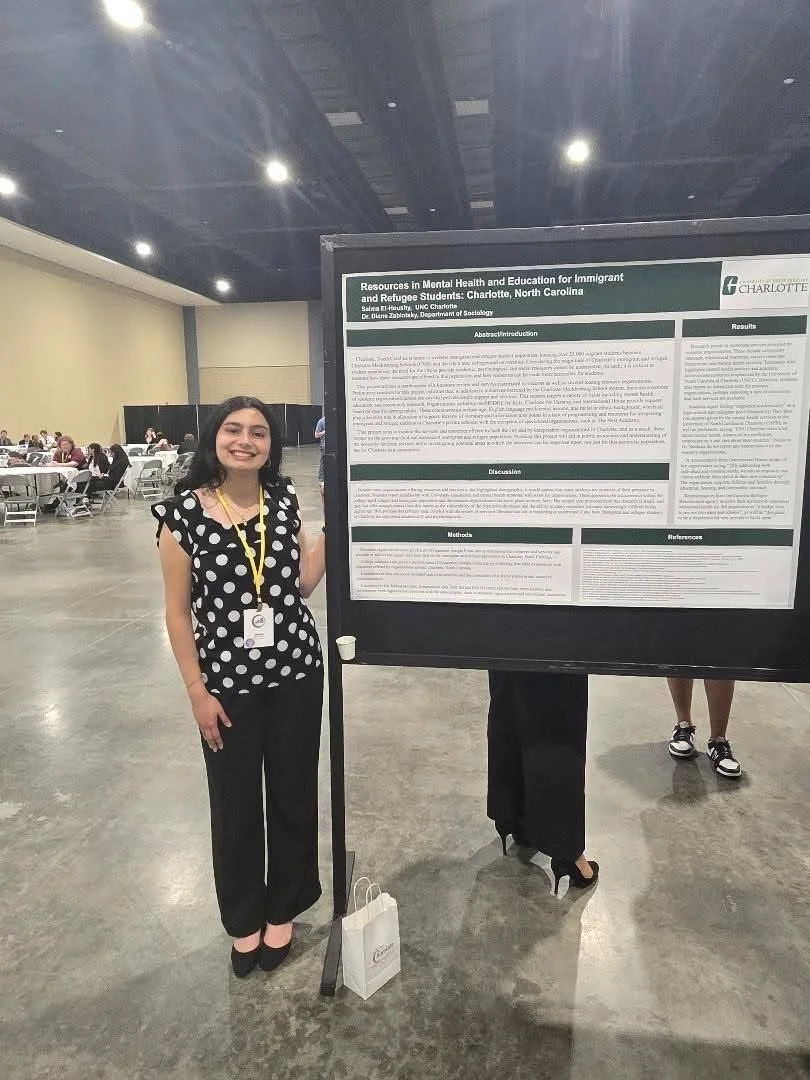
This is me at NCUR 2026 in Richmond, VA presenting my work!
As a psychology major with a strong interest in many of the other social sciences, it is research and work like this that drives me to continue my education. I want to be able to speak on issues that impact others, especially within mental health, and be able to help others as much as I can within this field. I can relate to many experiences that these students face, however, there are also parts of their struggles I cannot fully understand, since I am not an immigrant myself. This is why it is so important to highlight them and take the time to learn more. Helping underrepresented demographics helps us build deeper connections and understanding as a community. Equity and empathy are necessary qualities in a successful community, and we can build that by helping to bring up underrepresented groups!
All in all, I had such a great experience working on this project, and I fell in love with the research process. I am so excited to continue doing more research as a part of this journey!