
Untitled
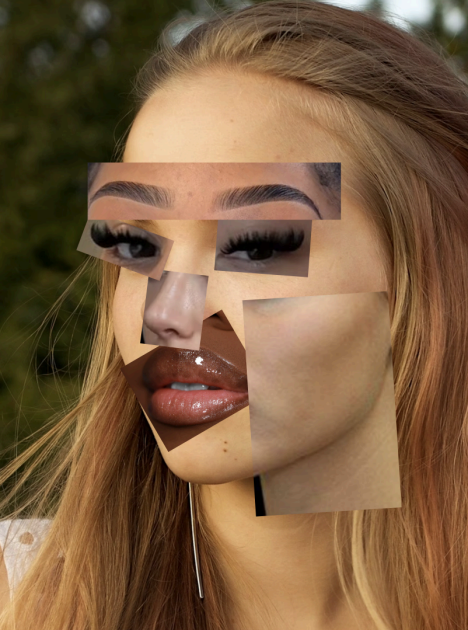
She told me once that she felt like God designed her to take up as little space as possible because there were already enough curvy Black women with hour glass figures walking around. I couldn’t tell if this was a joke or complaint, but I laughed anyway; she’s not at all the skinny twig that social media has made her think she is. Her oblong face shape is the first thing that speaks to me. Tawny, speckled skin, like a spread of crunchy peanut butter. Her hooked nose interrupts our conversation, my eyes sliding down the bump in her bridge, and falling onto her lips. A pink, plump, and shiny dead end bringing me back up to her eyes to finally meet her. Awww, they’re tiny. Little brown buttons with short lashes, weak bouncers for her eye contact. All faces have beautiful nuances if we take the time to get up close, and it will never cease to amaze me how we’ve learned to think otherwise.
“Your face is a combination of generations of people who fell in love.” This sweet sentiment resonated with many people online, being shared and reposted across several platforms, and temporarily empowering people to appreciate their natural features. However, it also left a sour aftertaste with a stinging reminder: their desired look was nothing like what their lineage left them. A slim face, cat-like eyes, tiny nose, perfect teeth, and plumped lips–these features collectively define today’s beauty standard and make up “iPhone face”, the name coined by Gen Z to describe the modern, homogenized beauty standard. It’s unclear when we decided this was beautiful, but it has since taken over, destroying all uniqueness in its path. People snort at the nubian nose their mother gave them and trade it for a small pointy one. People scowl at their square face from their father’s side and carve them into diamonds, foreshadowing–very real–beauty currency. Notice how whenever people start to get money or gain a following, their faces slowly change into iPhone face, each week bidding farewell to features like their broad noses or crooked teeth. This phenomenon hasn’t flown under the radar either and has been openly acknowledged online with the explanation that people aren’t ugly, they’re just poor. People can spend their money however they wish, but the metamorphosis into iPhone face is a quietly loud submission and declaration that natural uniqueness is undesirable and low class.
The beauty standard is also a conglomerate of multiple ethnic features, which are damaging to the communities who are expected to have them. Large hips, breasts, butt, and a tiny waist are most commonly natural to women of the African diaspora–and what most women are in the gym for today. So while this standard is a goal for many women, it's an expectation for others, to which ridicule awaits if they don’t meet it. Through child, teen, and adult years, Black women’s bodies must check every box or are often infantilized being seen as child-like or
underdeveloped. The expectation of a little girl to have a coke bottle figure is both mentally harmful and outright unrealistic, exposing the societal hypersexualization of Black women. Similarly, Latin women are expected to have perfect, sunkissed skin–not too light, certainly not too dark–and Asian women are expected to have that pale, glass skin. Yes, these features are natural for some, but they exclude the majority of women that aren’t on the media pedestal. Being Asian and having pale, blemish-free skin are not innate. Being Latin and having light, golden skin are not innate. A trip to real, unfiltered South America and Southeast Asia will reveal that truth. When all is considered, feeling like we don’t look like our community–even if in stereotypical ways– can seriously mess with our psyche, and make us feel like outsiders among our own people. So, beauty conformity is not only damaging to the masses, but also on a nuanced, molecular level for subcultures of women. And don’t be fooled; the beauty industry is well aware of this.
Under the guise of feminism smeared with innocent lip oils and setting sprays, the beauty industry has a more calculated endgame: to not only make you idolize iPhone face, but to hate yourself. Pay attention. A game changing beauty product and the “before” looks like you. Ads that list normal occurrences as problems. A random new product that miraculously fixes insecurities you didn’t know you should have been ashamed of; thank God they told you. Even down to the bone; Foundation is defined as the underlying basis for something (typically a building site) by The Oxford Dictionary and is also marketed as the first step in your makeup routine. They are literally telling you, to look presentable, you need to completely start over. Your original face? Scrap the whole thing and start over. Just like a construction site, you can’t work on top of ruins. All of it is intentional. And the gag is, it’s not about your happiness either. Beauty giants don’t care what face you want, as long as they are selling it, and you don’t have it. The constant game of cat and mouse between us and conformist beauty standards are what keep the beauty industry afloat. In other words, confident people are bad for business. Ironically though, the beauty standard is theoretically cyclical. Maybe iPhone face was breathtaking on the first few girls who had it, but eventually it becomes the norm. Then people start chasing a new look, bringing the whole thing full circle. Mind you, it’s not Instagram models that get casted on runways, it’s those who beautifully stand out. It’s you.
So even though society is constantly trying to push you into the abyss of conformity, keep your face. It’s the only one the world will ever see. That uniqueness is your greatest asset; don’t throw it away. And don’t just tolerate it either, love it. Knowing your value is the quiet rebellion that dismantles the propaganda of beauty standards, and brings a finally relieving liberation. And to that tawny, brown-eyed girl that spoke to me that time, I’ll try to remember this message the next time I see you in the mirror.