
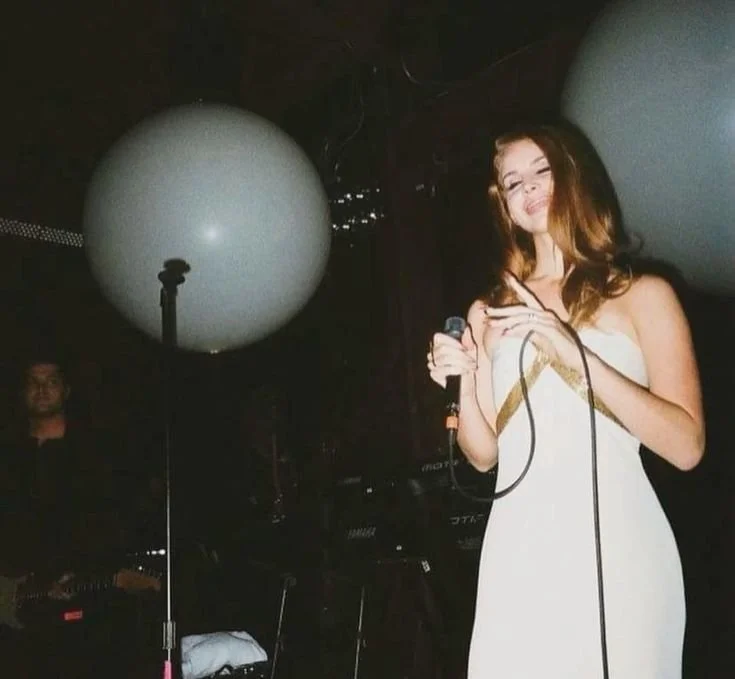
Photo Credits: Pinterest
Lana Del Rey puts her most authentic self into all of her work, and in each album she tells her stories, she echoes a plethora of personas that resonate with her and, amazingly, with her listeners. In her archived works, including her earliest albums, she shares narratives of a young gal and her sensitive temperament through tragic romance, melancholy, and the detached glamour of old Hollywood, bordering on a femme fatale-esque persona and Americana. As she matured with her voice and artistic identity, she still sings about love, but she also ventures out into other themes, contrasting with her earlier works where the persona she took on usually didn’t have her own agency and was stuck in the memories of heartbroken relationships; she now has control over her autonomy and has found reign over her choices and desires. However, she still believes in the importance and the fruit of love.
One thing I appreciate most about Lana Del Rey, and I think has helped her bridge the gap between who she was then and who she is now, is her honesty. She’s honest about her vulnerability, which we hear through her music, much of it inspired by her real life—and the raw emotions she brings to her voice. Her music transports people into the world of a mistress (e.g., “Sad Girl”), then into the world of a recipient affected by her depressed lover and trying to convince him it doesn’t have to be that way. (“Black Beauty”) Other times, she takes us to the perspective of a girl who can’t seem to get closer to this unreachable man that she’s fallen in love with (“Shades of Cool”) or to a world where she realizes she is free and has control over her own life. (“Get Free”)
Lana Del Rey also has a gift for lyricism, using wordplay like in “White Mustang,” blurring the car to suggest that this man is who she’s staying for. She draws references to songs, literature, and famous persons. It’s fascinating how extensive the references she makes are, such as the 1962 dystopian novel A Clockwork Orange, by Anthony Burgess, in her song “Ultraviolence,” Walt Whitman, Elvis Presley, and Marilyn Monroe in “Body Electric,” and T.S. Eliot’s Burnt Norton (“Burnt Norton - Interlude”). In her lyrics, she draws imagery that gives us a peek into her world. She has a talent for establishing these different kinds of worlds. In the “Born to Die” album, she sets a cool, edgy, film-noiresque world that is sometimes glamorous, yet heartbreaking and messy. In “Ultraviolence,” we sense an alt-rock ambiance that reflects the kind of man she was involved with. In her later albums, her songs have developed maturity through theme, lyricism, and sonics. However, she invites us into worlds that haven’t changed much from her younger years, but she engages with them from a mature perspective, and her response suggests that, even in her reluctance to leave the relationship, she is more willing to let go than in her earlier works. She draws out the scene around us in this world and familiarizes us with the person or people involved, what they must mean to her, and why they’ve made her feel this way. Oddly, we’re drawn to this. Her music and experiences speak to girls of all ages, inviting them to feel seen and understood.
Love has been a recurring theme throughout her work, and it’s explored in many interesting ways. In some parts, there are hints that Lana might feel helpless in that she is doomed to only a certain kind of love (“Henry, Come On") or that she is beyond the guy that she’s with (“Brooklyn Baby”). In other parts, she’s reluctant but knows she needs to leave an unsustainable relationship (“White Mustang”), or she's exhausted by a man who can’t accept himself and is inconsistent with who he is around her and around others (“Thunder”). Shown in all these ways, love has always coexisted alongside violence and despair in that she can’t ever change the men she’s with, or that she can’t escape from being with such men. Her honesty in being vulnerable with herself and us, knowing herself, is what has created the consistent flow in her career, keeping us anticipating what comes next. I think in some ways, she’s always known what she wanted. And even if she didn’t know, she’s always been consistent in her preferences, in what she likes. In this authenticity, she has been honest with herself and with those who listen to her.